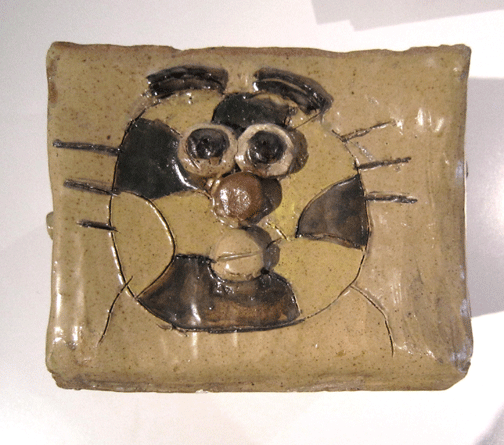
The Maira Kalman exhibition at the Jewish Museum is the first major survey of the artist's storytelling art. It is composed of paintings that include "stories" about her life, her travels, and especially, her witty ideas about people. The show includes Maira's furniture and papers that give you the feeling that you are in Maira's home.
At the end of the blog, we included some links to Maira’s work, to her amazing books for children, to her journalism blogs for the New York Times and New Yorker magazine, to her product designs, and some amazing paintings that tell her personal stories.
At the end of the blog, we included some links to Maira’s work, to her amazing books for children, to her journalism blogs for the New York Times and New Yorker magazine, to her product designs, and some amazing paintings that tell her personal stories.
We loved looking at Maira’s paintings online and listening to these audios by her friends:

Maira Kalman
Sunny Day at the Park, 2004
Gouache on paper
8 1/4 x 8 3/4 in.
Courtesy of Julie Saul
Peter Barberie speaks about Sunny Day at the Park:
AUDIO
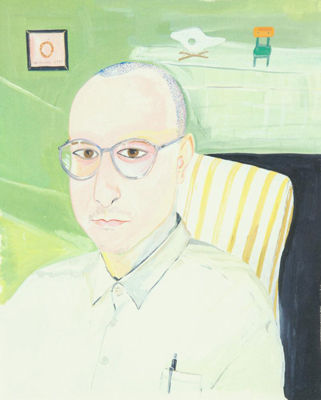
Maira Kalman
Tibor Kalman, 1998
Gouache on paper
15 1/4 x 11 3/4 in.
Courtesy of the artist
The artist’s late husband and founder of the radical design firm M&Co (note the onion ring, one of a collection represented by examples on view in this show, along with M&Co objects and ephemera that the Kalmans collaborated on).
Michael Bierut speaks about Tibor Kalman:
AUDIO

Maira Kalman
2 Million People, 2009
Gouache on paper
10 3/4 x 15 in.
Courtesy of the artist and Julie Saul Gallery, New York
The style of Kalman’s work exudes a sense of lightness, joy, and charm. Righteous for cake, this style can be disarming when the subject is serious or tragic (the Blitz, 9/11). But this is exactly the point! Keeping things light—in light of the sadness, loss, and strong emotion that are always present in her work—is what dis¬tractions are for. In Kalman’s world, humor and a keen sense of the absurd are instrumental!
Stamatina Gregory speaks about 2 Million People:
AUDIO

Maira Kalman and Rick Meyerowitz
New Yorkistan, 2001
Gouache and pencil on paper
20 x 14 3/4 in. Collection of Erica and Eric Schwartz
The December 10, 2001, New Yorker featured Kalman’s most recognized image on the cover, made in collaboration with Rick Meyerowitz. This is a preliminary sketch. Writing and drawing play equal roles in the work of Kalman, who is an author, illus¬trator, and designer. This show focuses on the pictorial part of her art by presenting original works on paper for her illustrations. Maira is one of today’s most revered creative artists.
Maira Kalman and Rick Meyerowitz speak about New Yorkistan:
AUDIO

Self-Portrait (Favorite Jacket), 1991
Pencil, color pencil, and ink on paper
12 5/8 x 9 3/4 in.
Courtesy of the artist
Maira Kalman’s art is a discipline of daily creativity. Taking photos, collecting objects and arranging them, writing in notebooks, drawing in journals, painting pictures, making lists—these are all relatively intimate and ordinary activities.
Isaac Mizrahi speaks about Self-Portrait (Favorite Jacket):
AUDIO

Sentence Fragment, 2004-2005
Gouache on paper
12 3/4 x 10 3/4 in.
Courtesy of the artist
Sentence Fragment is from Kalman’s illustrated edition of William Strunk, Jr., and E. B. White’s timeless grammar guide, The Elements of Style.
Nico Muhly speaks about Sentence Fragment:
AUDIO

Herring and Philosophy Club, 2006
Gouache on paper
9 3/4 x 14 1/2 in.
Collection of Ellen and Robert Grimes
Ruth Reichl speaks about Herring & Philosophy Club:
AUDIO

Man Dances on Salt, 2007
Gouache on paper
9 x 7 3/4 in.
Collection of Tom and Claire O’Connor
Kalman’s book The Principles of Uncertainty featured this emblematic image on the cover.
David Shipley speaks about Man Dances on Salt
AUDIO

Max, 1991
Gouache on paper
17 x 14 in.
Courtesy of the artist
Max Stravinksy is the dog poet and star of a series of Kalman’s books.Max

Crosstown Boogie Woogie, 1995
Gouache on paper
15 3/8 x 11 1/2 in.
Courtesy of the artist
Kalman’s work appeared on the cover of The New Yorker for the first time in the December 4, 1995, issue.

My Mother in Organza, 2003
Gouache and pencil on paper
14 x 11 1/4 in.
Courtesy of the artist
Kalman is seen as a child with her mother (left) in Tel Aviv.

Abraham Lincoln, 2004-2005
Gouache on paper
15 x 11 in.
Courtesy of the artist
Long an admirer of Lincoln, Kalman is a contributor to the Rosenbach Museum and Library’s online project “21st Century Abe.”

Le Corbusier Sink, 2006
Gouache on paper
7 3/4 x 7 1/2 in.
Collection of Jane and Patrick Curley
People, places, dogs, dreams, objects, food . . . Maira Kalman’s narrative art comes from her everyday observation of ordinary things (show¬ing them to be extraordinary) and profound events (showing them to be simply part of life).

Panache, 2009
Gouache on paper
11 x 18 in.
Courtesy of the artist
Panache is from Kalman’s most recent children’s book, 13 Words, with text by Lemony Snicket (fashion hounds: note the Schiaparelli Shoe Hat).

Matisse in Nice, 2004-2005
Gouache on paper
12 x 10 3/8 in.
Courtesy of the artist
Maira Kalman: Various Illuminations (of a Crazy World)
From March 11, 2011 to July 31, 2011
Start your visit to the Maira Kalman exhibition with this link to Maira’s paintings. Listen to the audio by her dear friends. It will give you an idea of Maira’s charm and wit and the warm affection she inspires.
Here is one of Maira’s amazing blogs, “And the Pursuit of Happiness" for the NYTimes. This post is titled “Sorry, the Rest Unknown.”
Another of Maira’s NYTimes blogs “The Inauguration. At Last.”
Maira’s “Finding Lincoln” blog
At Maira’s website you will find categories of her work: books, journalism, new yorker, products, serendipity, about and contact. Click on ‘books' and look at her delightful children's books. Then, look at her ‘books for adults.’ Check out "The Principles of Uncertainty.” It's got lots of Maira’s paintings and witty comments.
There is great stuff here. Click on ‘journalism,’ then Style, then “Couture Voyeur.” Click on ‘Mad About Me.’ Click on ‘The Splendid Gardner’ about Vita Sackville West.
Here is some information about the Jewish museum:
The Jewish Museum
1109 Fifth Avenue at 92nd Street
New York, NY 10128
Admission
Adults: $12
Seniors/65 & over: $10
Students: $ 7.50
Children under 12: Free
Jewish Museum Members: Free
Saturdays: Free more
Seniors/65 & over: $10
Students: $ 7.50
Children under 12: Free
Jewish Museum Members: Free
Saturdays: Free more
The Museum is closed for all major Jewish holidays,
including these in Spring 2011:
Passover Eve - Monday, April 18, Early Closing 2pm
Passover (1st Day) - Tuesday, April 19
Passover (2nd Day) - Wednesday, April 20
Passover (7th Day) - Monday, April 25
Passover (8th Day) - Tuesday, April 26
Shavuot (1st Day) - Wednesday, June 8
Shavuot (2nd Day) - Thursday, June 9
including these in Spring 2011:
Passover Eve - Monday, April 18, Early Closing 2pm
Passover (1st Day) - Tuesday, April 19
Passover (2nd Day) - Wednesday, April 20
Passover (7th Day) - Monday, April 25
Passover (8th Day) - Tuesday, April 26
Shavuot (1st Day) - Wednesday, June 8
Shavuot (2nd Day) - Thursday, June 9
You might want to check out these Daily Tours
The Jewish Museum offers daily tours, during the week, of its special and permanent exhibition to all visitors free with Museum admission. Please check the schedule below for tour times.
These 45 minute tours are led by Museum-trained docents and meet in the Museum lobby at the following scheduled times throughout the day.
Mondays
12:15pm ׀ Maira Kalman: Various Illuminations (of a Crazy World)
more about the exhibition
3:15pm ׀ Maira Kalman: Various Illuminations (of a Crazy World)
more about the exhibition
Tuesdays and Thursdays
12:15pm ׀ Maira Kalman: Various Illuminations (of a Crazy World)
more about the exhibition
3:15pm ׀ Maira Kalman: Various Illuminations (of a Crazy World)
more about the exhibition
Thursday Evenings
6:15pm ׀ Maira Kalman: Various Illuminations (of a Crazy World)
more about the exhibition
Fridays
12:15pm ׀ Maira Kalman: Various Illuminations (of a Crazy World)
The Jewish Museum offers daily tours, during the week, of its special and permanent exhibition to all visitors free with Museum admission. Please check the schedule below for tour times.
These 45 minute tours are led by Museum-trained docents and meet in the Museum lobby at the following scheduled times throughout the day.
Mondays
12:15pm ׀ Maira Kalman: Various Illuminations (of a Crazy World)
more about the exhibition
3:15pm ׀ Maira Kalman: Various Illuminations (of a Crazy World)
more about the exhibition
Tuesdays and Thursdays
12:15pm ׀ Maira Kalman: Various Illuminations (of a Crazy World)
more about the exhibition
3:15pm ׀ Maira Kalman: Various Illuminations (of a Crazy World)
more about the exhibition
Thursday Evenings
6:15pm ׀ Maira Kalman: Various Illuminations (of a Crazy World)
more about the exhibition
Fridays
12:15pm ׀ Maira Kalman: Various Illuminations (of a Crazy World)
Enjoy!