Wednesday, October 19, 2011

Art Tour: Chelsea 10/11


Art Tour: Chelsea October 19, 2011, 11:00 am. For parents with young children:

C’mon along, let artbusnyc take you by the hand. Pack up your toddler, your Cheerios, release the brake on your stroller, jump in a cab, and meet us on Wednesday, October 19th, at 11:00 am, to visit 3 art galleries in Chelsea.

First stop:

The Pace Gallery: 545 West 22nd Street. Carsten Nicolai, until October 22, 2011


A white parachute lies on the floor in front of a large fan. Every four minutes, the fan is turned on. The fan makes a very loud noise.  The wind inflates the parachute and it leaps up into the air. It’s fun to watch.

The artist is Carsten Nicolai. The exhibit is called “Pionier.,” the german word for “pioneer.” Nicolai’s work operates on the borders of art and science. His exhibition resembles a scientific laboratory, where calculations and tests are performed. 

Second stop:

Sikkema Jenkins & Co. 530 West 22nd Street. Vik Muniz to October 15, 2011.

Muniz presents new  large-scale photographs that recreate historical paintings with torn strips of magazine photos. He reminds us of the overwhelming flow of information in modern life.


Project 
Create images of animals using bits of torn paper from magazine images. Photograph your images.


Yancy Richardson Gallery: 535 West 22nd Street. Hellen van Meene, until October 22, 2011

Yancy Richardson Gallery exhibits the work of photographers. Hellen van Meene was born in 1972, in the Netherlands. She lives and works there. This is her third show at Yancy Richardson.

The exhibition includes several beautiful portraits of young women that van Meene photographed in Russia and the Netherlands, and formal portraits of dogs. Van Meene photographed the dogs in an outdoor studio she created to highlight the character of each dog. They are funny and fun.


Third stop: West 24th Street...

Gagosian Gallery: 555 West 24th Street. Richard Serra, until November 26, 2011

The artist is Richard Serra. Two new sculptures fill the gallery space. They are giant metals spirals tipped at angles that  seem to defy gravity. Mr. Serra’s father worked in shipyards, and Serra’s sculptures can suggest the inverted hulls of tankers.

When you walk in and out of Serra's huge sculptures, they make feel you might be in Gulliver’s Travels, like the tiny Lilliputians, discovering the giant world of humans.


Next Month: Art Tours November-December 2011

Be sure to follow artbusnyc next month. Art Tours will return to Yancy Richardson, to see the gorgeous, old master-inspired photographs of Sharon Core, October 27-December 23, 2011:


Project

Sharon Core replicates and then photographs the food and flower paintings of old and modern masters, with real food and real flowers. Core admires the Dutch painters, Bosschaert and Jan Breughel, and the Modernist painters, Odilon Redon and Fantin-LaTour. See if you can find paintings by these masters online. Try to replicate them with real food and flowers. Take photographs of your compositions.

Wednesday, October 12, 2011

Studio Project: Watercolors 2


Here are some notes on a fun art session with a toddler: ...a watercolor workshop.

The quick set-up: Put a thin plastic drop-cloth on the dining table. Pull up a chair. Put out a pan of Crayola watercolors (bought in the supermarket),  a jar of water, some paper towels, a pad of paper (tear off a few sheets), a brush, (try a new long-handled artist's brush). It would be nice to have a beautiful sunny day bouncing warm light into the room. Clear a nice exhibition wall. Tear off some small pieces of scotch tape (for the exhibition). Take out your point-and-shoot camera. (You don't want to miss these shots.) OK. Ready, set, paint.

Today, we painted people...a nice circle for the head...large round dots for eyes...a smiling mouth...hair...a sort of triangular shape for a dress...arms...legs. (Take a photo.) Finished. Do another one...same way...then another...then another. (Photo.) Four paintings with roughly the same size figure. A series. Nicely done. Tape the paintings to the exhibition wall. Yea! (Photo)


Gallery Visit: Red Grooms at Marlborough


Red Grooms did this painting of himself. Notice his red hair. Grooms (b 1937) is a multi-media artist. That means he likes to work with different materials: paint, wood, metal, plastic, and put them together. Here is his idea of a store with a stroller passing by:


Grooms is funny.  His art is about New York places and New York people. Here is his newsstand:


Here is a little street cart that sells soda. He sees something interesting in the things that we see every day. Would you do a painting of traffic? Here is Grooms's idea of traffic:


Here is Grooms's idea of Saks Fifth Avenue, a great New York department store:


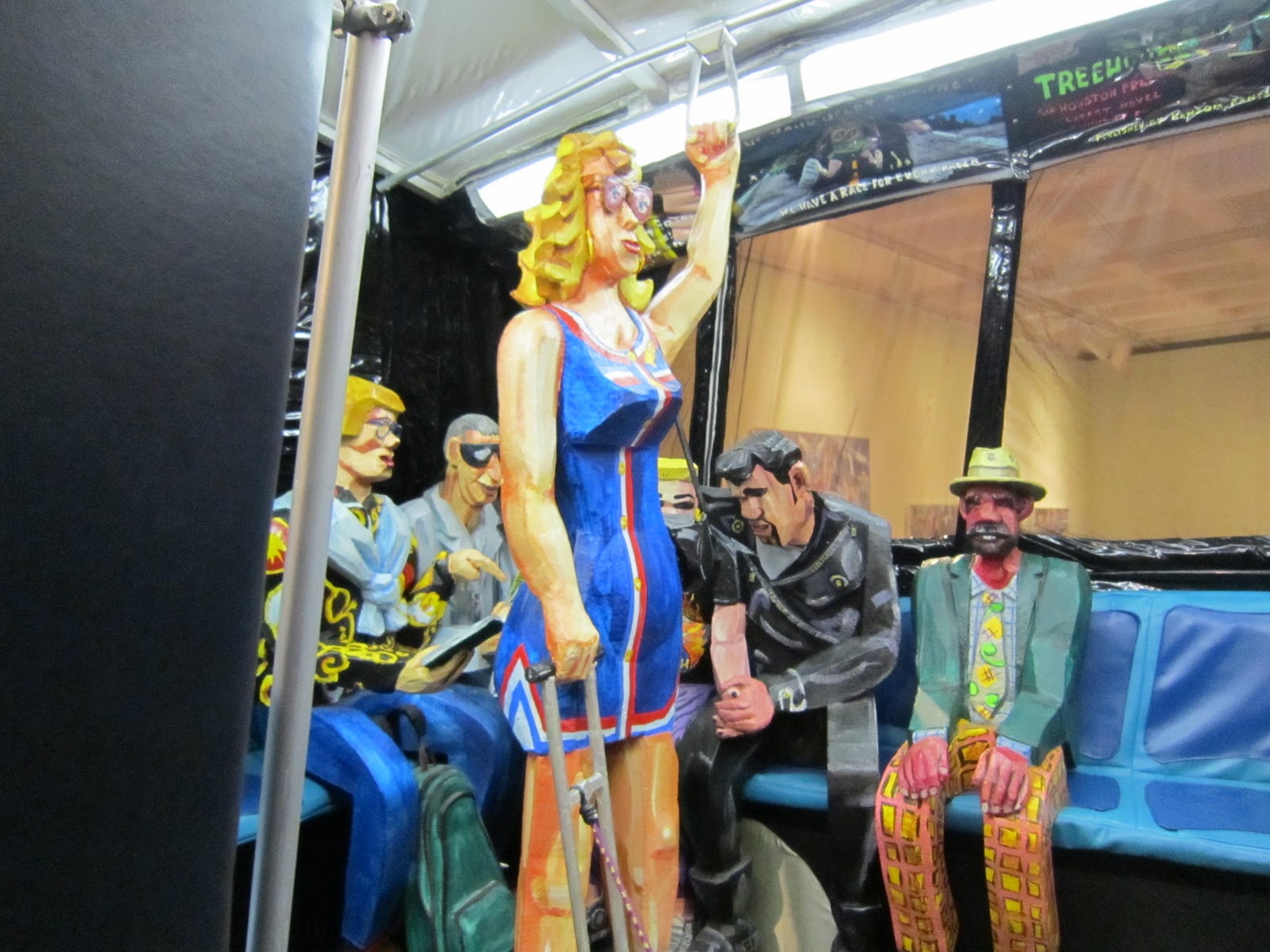
He can see something wonderful in the things we see every day, like a city bus. A city bus???? He built this life-size, city bus. He sewed plastic sheets together and stretched them over a metal frame.  The bus looks real. You are surprised to see it in a room, in an art gallery. Pretty funny.


You can even step inside the bus and see his life-size wood sculptures of people sitting on the seats. It is an amazing art work. Here are his sculptures of some passengers:


This is the side of the bus, with a poster advertising the  "Bingling Brothers Circus." (Zoom in on this photo to make it larger.)


Red Grooms is a very special artist. He can be funny, but he can be serious too. After I left his exhibition and walked outside, I saw the traffic, the people, and the buses, in a new way. Everywhere I looked I saw art. Thank you Red Grooms.


An artbusnyc Zoo Project

This is how you and your child can make a multi-media construction like the constructions of Red Grooms:

Take some photos at the New York zoo.  Try to take one very wide photograph of the whole zoo. (This will be your background.) Photograph some of the cages and the animals. Photograph some of the people. Print the photographs. Paste them on heavy paper. Cut them out. Leave some extra paper at the bottom of each cutout. (You will fold this back to make a stand for your cutouts.)  Glue your "background" to a cardboard box (so it stands). Use a piece of cardboard for the ground. (Arrange your cutouts on the cardboard, and design your zoo. When you like your design, glue the cutouts to the cardboard. There. Now you have a zoo kind of like a Red Grooms construction.

The Red Grooms exhibition was at the Marlborough Gallery at 40 West 57th Street until October 22, 2011. 

Tuesday, September 20, 2011

Studio Visit: Anna Schrage PS1


Anna Schrage Performs a Painting

Anna  Schrage is an artist. She was born in Germany. She lives and works in New York City. Anna creates videotapes of herself while she is painting. Her idea is to "perform" her painting process for an audience, like a dancer, or, a musician. As she explains, “I am looking for an exchange between the artist and the audience, like performing artists do on stage." 

Here are some stills of Anna painting, taken from one of Anna's recent videos.


Project
This is a project inspired by Anna Schrage's "performance" art that you can do at home: Use your "point-and-shoot" camera to make a video of yourself doing a painting. Talk about what you are doing. Talk about the materials you are using, the paints, the markers. Do you feel this is like a  “performance?” Do you want people to applaud when you finish your painting?

Monday, September 12, 2011

Studio Visit: Puppet Horse TED


Here is a most amazing, life-size horse puppet. It is made of wood and very thin fabric. Two people make it move from the inside; a third person works it from the outside. It is very life-like. It walks and runs. It snorts and breathes. Its ears turn. People ride on it.

The puppet was built by a very talented puppet company called Handspring.

These photographs were part of a video at TED, an online conference that features presentations by people in the arts and science. See the link to TED below.


Project
Pretend you are a horse. Use a large, thin scarf to cover yourself. How would a horse move? How would a horse sound? Make up a story about a horse. Make a video about your horse.

Here is a link to TED and this video about the horse puppet and the company that made it.


Thursday, September 8, 2011

Studio Project: Watercolors 1

----
This is a story about two four-year old friends, Sophia and Lucy painting watercolors on a rainy day. You can try this at your home.

Project: "Watercolors"


The art materials you will need: 
(You can find them in most supermarkets.)
A pan of Crayola washable watercolors
A package of Crayola paint brushes
A box of Crayola washable magic markers
A box of Crayola washable glitter pens
A sketch pad 9 x 12” (?)
A roll of Scotch tape (easy release)


You can set up an art studio on a large dining table.

This is how the watercolor playdate at Sophia's house worked:

Sophia said to her friend Lucy, "let's do art." She proceeded to take out the pan of Crayola watercolors and art materials we had bought that morning at the supermarket.

Sophia put the art materials on the big round dining table.

She tore off some paper towels. She would put one under her painting to protect the table and use one to  dry her brush.

She gave two towels to Lucy.

She filled two small bowls with water and put them on the table.

She set out two brushes and the pan of watercolors.

She put the magic markers and the glitter pens on the table.

She put the sketch pad on the table.

She tore off two pages and gave one to Janie. 

They were ready to paint.

They sat down at the table.

Sophia dipped her brush in the water and stroked the purple watercolor.

She painted a few purple strokes on the paper.

Lucy wet her brush and painted a few strokes of red.

Sophia looked over at Lucy's painting and said, “That’s beautiful.”

Sophia washed her brush. She took some blue and stroked it on the paper.

She said “Lucy, look at this blue.”

Lucy looked at the blue and said "It's beautiful."


Sophia washed her brush and dried it on the paper towel.

She wet her brush in the water and then dipped it in the green.

She put long, curving, green strokes on her painting.

Lucy put long, curving, red strokes on her painting.

Sophia washed her brush, and took some red.

Lucy washed her brush and took some yellow.

Sophia looked at her painting and said, “It’s a rainbow."


She let the paint dry a bit.

She took a red magic marker and drew some curly lines on the rainbow.

She opened a glitter pen and dribbled a line of glitter on the rainbow.

Lucy drew some lines on her painting with a blue marker and added a line of glitter.

Sophia opened the roll of Scotch tape.

She tore off some small pieces and stuck them to the tops of the paintings.


She mounted the paintings on the kitchen door.


The girls stood back and smiled. “It’s an exhibit,” Sophia said.

They were very pleased.

Sophia took the bowls of muddy water to the sink.

She emptied them and filled them with clean water.

She put the fresh bowls of water and some clean paper towels on the table. 

Sophia and Lucy did some more paintings.

Lucy dipped her brush in the bright blue color.

She said "Sophia, look at this beautiful blue.”

Sophia agreed. She took some of the bright blue on her brush and said “It's beautiful.”

Lucy's baby sister, Emma, a lively 2 year old, and her Mom, joined them at the table.

Baby Emma wanted to paint too.

She pointed to the blue and said, “Booo.”

Sophie found a brush and some paper for Emma.

Emma's Mom showed her how to wet her brush and dip it in the paint.

Emma painted a stroke and giggled.

Sophie taped all of their new paintings to the kitchen door. Beautiful.

The girls stood back and admired their work.

Just then, Sophia's Mom announced that it was dinner time.

The girls did not want to stop painting,

but Sophia said “We can do art again soon.”

Lucy said “Yes, let's do art again soon.”

Baby Emma pointed to the watercolors and said “Booo.”

artbusnyc project

Plan a "watercolor" playdate. Invite a friend to come to your house. Buy some Crayola art materials at the supermarket. Invite your friend to do some watercolors with you. Put the art materials out on the dining table. Paint some beautiful watercolors. Tape them to a door for an exhibit. Invite people to see your exhibit. Talk about your paintings. Take photos of your exhibit. Save your art in a portfolio. Save your photos in an album.


Wednesday, July 27, 2011

Studio Visit: Jasper Johns


 Jasper Johns Is Smiling


Jasper Johns, contemporary American artist.  Jasper Johns was born in 1930 in Augusta, Georgia, and raised in South Carolina. He began drawing as a young child, and from the age of five knew he wanted to be an artist. He moved to New York in 1953. 


Jasper Johns liked to paint subjects "the eye already knows," everyday objects, like beer cans. BEER CANS?? Johns wants us to think about what art is, what we can call a painting or a sculpture. So he smiled, and made quiet little jokes, like beer cans.


Johns was probably smiling when he created his "Beer Cans" sculpture. Most people throw empty beer cans in the garbage, but Johns had two beer cans cast in bronze. And then he painted them to look EXACTLY like real beer cans. The "Beer Cans" sculpture was Johns's little joke, but it was a very beautiful little joke.


When Johns did this amazing bronze sculpture of his paint brushes soaking in an old Savarin coffee can, he was definitely smiling. Johns had the brushes and the Savarin can cast in bronze, and then painted them to look real. It was brilliant. This is one of Johns's most famous art works.

Johns liked to do drawings and prints of his paintings and sculpture. Here is his black and gray print of the Savarin sculpture. 


Johns began a series of flag paintings in 1954. This painting is titled "The White Flag." It is the largest of Johns's flag paintings,  78" x 120." It remained in Johns's own collection until the Metropolitan Museum bought it in 1998. 


In 1955, Johns painted this red, white and blue flag...  


Johns painted his flag paintings with "encaustic," color mixed with wax, like melted crayons. It's lovely to use, dries fast, doesn't smear, and the color can be painted over and over itself in many layers. He painted it over small bits of newspaper he had glued to the canvas. The paintings were fabulous. You could see a little bit of the newspaper showing through the color. It was a completely new way to use encaustic. Very "modern."


 Johns's flag paintings and drawings were exciting. His friend, the artist Robert Rauschenberg, invited the gallery owner, Leo Castelli, to visit Johns's studio to see his flag paintings. Castelli's often showed the work of new young artists in his gallery. Castelli was impressed with Johns's paintings and offered to give Johns a "one-man-show."


This is one of Johns's flag drawings. Castelli used it as the poster for Johns's exhibition at the gallery.


Next, Johns did a series of  paintings and drawings of "targets."


Here is one of Johns's extraordinary "target" drawings.


Then came Johns's paintings, and drawings of letters.


Here is Johns's elegant drawing of letters one over the other.


Johns did paintings and drawings and prints of the numbers 0 through 9.


Here is Johns's drawing of the numbers 0 through 9 drawn one over the other.


In 1966, Johns painted a series of maps of the United States.


Johns painted a series of "hatching" paintings. They remind me of "finger painting." prints.


He explored the idea of hatching in many paintings and drawings. They are some of his most beautiful, and serious, work.


Johns included his "Savarin Can" in this painting, many years later. Note the hand prints in the hatching.


Later in his career, Johns painted some more mysterious images, like this four-panel painting called "The Four Seasons."


In 2011, Johns's show at the Matthew Marks Gallery, returned back to his idea of numbers from 0 to 9, but he explored them in sculpture. 


Here is one of the numbers sculptures.


The Metropolitan Museum of Art has called  Johns one of the greatest artists of the 20th Century. See the link to Johns at the Metropolitan Museum, below.


Here are some Johns-inspired projects you can try at home.


Numbers: You can buy stencils for the numbers one through 9 in an art store (letter stencils too.) Do some paintings and drawings using numbers (and or letters). 
Letters: You can buy an alphabet of rubber stamps in a toy store. Buy an ink stamp pad. Or, you can use some paint. Do some prints using the letter stamps.
Maps: You can photocopy maps of the states of the US. Paint over them with tempera paint. Then, add the names of the states with stamps, on them.
Encaustic: You can iron a sheet of paper to heat it up. Draw on it with a crayon while it is still warm. It will melt the crayon a little. 
Grid: You can fold a paper into rectangles. Fill in each rectangle with color to create a colorful background grid. Draw or paint a number in each rectangle. Or, using colored paper, cut out letters or numbers, and glue them on the grid.


Here are some links to more information about the artist, Jasper Johns.


At the Metropolitan Museum of Art:
http://www.metmuseum.org/toah/works-of-art/


At Gagosian gallery: